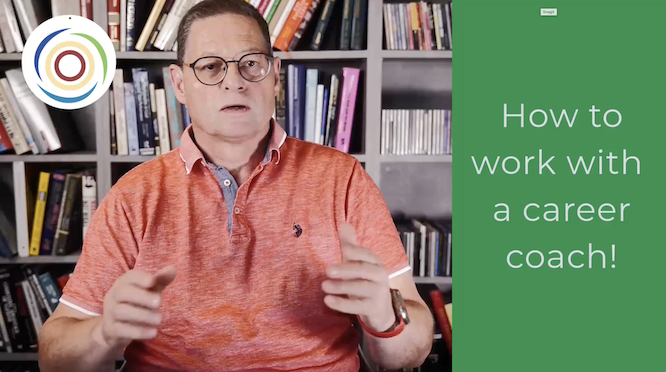
How to work with a career coach!
This is the third article in this series.
The first was: Why you profit from working with a career coach!
The second had the title: How to select the right career coach!
Let's assume you selected a coach.
At the start of coaching, clarify the main terms, including goals, confidentiality, and financials.
Check out video 2 if you want to know more about these topics.
The corresponding video to this article can be found on YouTube.
TOPICS
Should you stay in your current company?
Should you change industries?
Should you become an entrepreneur?
Should you develop new skills?
These are typical questions, but the answers differ from person to person. Family situation, age, gender, the labor market, and, last but not least, your personality all factor into the equation. And there is more.
A 23-year-old person, not in a permanent relationship, graduating with a bachelor's degree, with some student loan debt, and facing labor market constraints as artificial intelligence takes over entry-level jobs, has specific challenges and opportunities.
This situation differs widely from someone in their fifties with an accomplished job record and a stable financial position.
QUEST FOR MEANING
Over the last few years, I've found that the quest for personal meaning and purpose has become more significant for all age groups. As a result, "What creates meaning for you?" is often the first riddle to solve.
PERSONALITY PREFERENCES, TALENTS, AND SKILLS
Next, clarify personality preferences, talents, and specific skills and interests. When you have clarity, many things will fall into place. It will not guarantee success, but it will most probably keep you from accepting jobs that will make you unhappy.
LIFE AND CAREER
Don't forget: your life is much broader than your career. Your career might span 40 years, and your life 80-plus years. In fact, your career happens as part of your life.
Your life goes far beyond work-life balance, the healthy equilibrium between a person's work responsibilities and their personal life, including family, health, and hobbies.
Depending on your life and career stage, your priorities for work-life balance will change. Assume you are 25, have a master's degree, and the opportunity opens up to be a corporate founder. You and your teammates have a promising idea, have developed a prototype, and are in contact with a group of investors. Your private life will have to take a back seat for the next few years. You'll have to dedicate your energy and time to making this idea fly, or it won't succeed. If you succeed, you might have the opportunity to stay in the race with more time for your private life and health. You might sell your shares and stay a private person for the rest of your life.
Here is another situation. A couple in their 30s, well qualified, with some money in the bank, and considering having children, both with corporate jobs that allow part-time work, has completely different options.
Many people 50-plus face career challenges they didn't expect when they graduated and joined a big corporation such as Siemens or Volkswagen. Their parents, now retired, might have spent their whole career with these companies. And now they are being shown the door—if they are lucky, with a golden parachute. But they might still have 10 to 15 years before they can retire. They might have deep domain expertise, but technological changes might make it irrelevant. And what about their skill set? Can they make use of Artificial Intelligence and other technologies?
CAREER STRATEGY
Based on the topics we discussed earlier, you can develop a career strategy.
Short: Coming year - the next 3 to 12 months
Medium: 1- 3 years
Long-term: 3 plus years
Developing a career strategy in an age where humans compete with AI and AI agents is challenging. Yes, strategies work, but they go beyond this video. Maybe I will address it in another one.
ACTION PLAN

If you want to make God laugh, tell him your plans.
Plan anyway!
A career strategy without an actionable plan is not worth much.
Your short- and medium-term strategies should have an action plan.
Based on that, act! Life will respond to your actions, and the creative journey starts. And yes, you will have to adapt your strategy and plan. New opportunities may appear, and you won't want to miss them!
ROLES OF A CAREER COACH
A career coach has two main roles: expert and process facilitator.
As an expert, he should have the following content experience:
Career Development – career planning, transitions, stages, employability, and adaptability
Labor-Market Knowledge – occupations, industry trends, skills in demand, and future-of-work developments
Recruitment & Selection – CVs, applications, interviews, assessment, and employer expectations
Organizations & Management – leadership, organizational culture, change, and internal career paths
Skills & Competencies – technical, digital, AI, leadership, interpersonal, and transferable skills
Personality & Assessment – personality, interests, values, motivation, strengths, and competencies
Education & Professional Development – degrees, certifications, reskilling, upskilling, and lifelong learning
Depending on your specific topic, some of these competency areas will be more important than others.
As a process facilitator, he should have the following content experience:
Active Listening & Questioning – listening deeply and asking powerful, relevant questions.
Goal Setting & Contracting – defining objectives, expectations, roles, boundaries, and desired outcomes.
Self-Reflection & Insight – helping clients recognize patterns, assumptions, strengths, values, and blind spots.
Option Generation & Exploration – helping clients develop and evaluate different career possibilities.
Action Planning & Accountability – translating decisions into realistic actions, milestones, and commitments.
Feedback & Challenge – providing constructive feedback and respectfully challenging assumptions or limiting beliefs.
Managing the Coaching Process – creating structure across sessions, maintaining focus, adapting the process, and
That's quite a lot. 😉
YOUR CONTRIBUTION TO MAKE IT A SUCCESS
You, the client, are an active partner in career coaching. The coach can provide expertise, structure, questions, and feedback, but you, the client, ultimately determine the process's quality and outcome.
Here are the main topics:
Openness – being willing to explore experiences, assumptions, strengths, weaknesses, and uncertainties.
Self-Reflection – thinking honestly about values, motivations, interests, personality, and career aspirations.
Active Participation – engaging in discussions, exercises, assessments, and decision-making.
Honesty & Authenticity – sharing relevant information openly, including doubts, concerns, and setbacks.
Willingness to Be Challenged – being prepared to question existing beliefs and consider new perspectives.
Commitment to Action – turning insights and decisions into concrete steps between coaching sessions.
Responsibility & Ownership – making your own decisions and taking responsibility for implementing them.
We covered a lot of ground in this article.
FINALLY
Your life and career definitely connect with your quest for meaning if you want the energy to cope well with the challenges that arise.
Be meaningful and curious!
The corresponding video to this article can be found on YouTube.
RIGHTS AND DISCLOSURE
© Dr. Günther Singer - All rights reserved
Pictures created with the support of AI
Design by Flow of Light
